The
Blog
August 23, 2026
“A chemostat-based model for growing bacterial biofilms” is published in Microbiology Spectrum
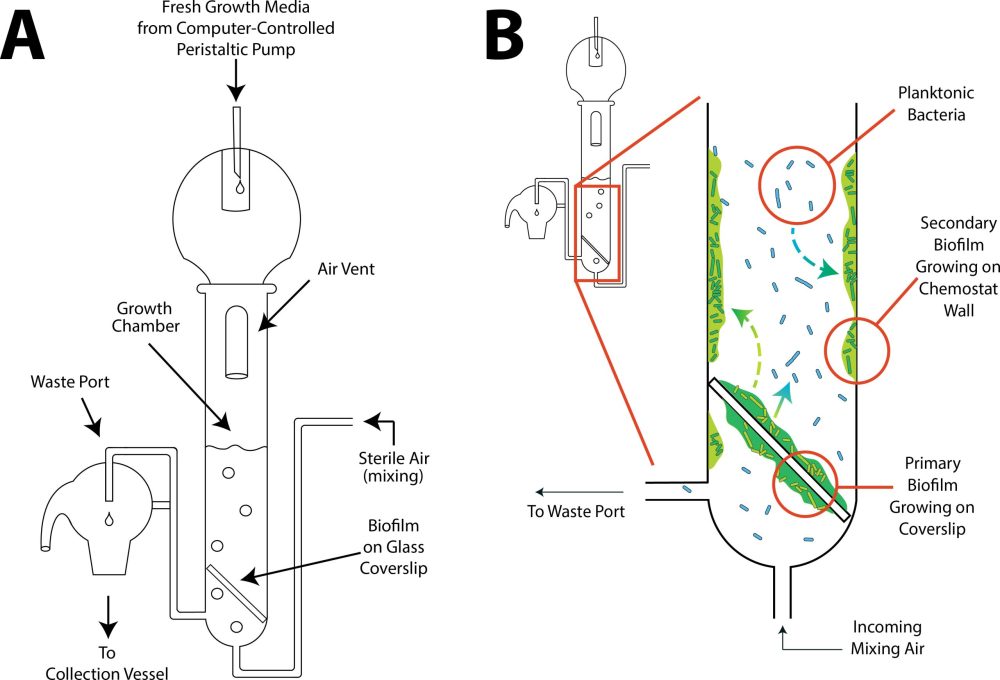
In this paper, we introduce a continuous-culture system designed to study biofilms under more realistic and controllable conditions. Using Pseudomonas aeruginosa, we found that biofilms grew larger in chemostats than in conventional flask cultures. More importantly, the system enables the study of three connected populations: established “primary” biofilms, free-living planktonic bacteria released from those biofilms, and new “secondary” biofilms that form on the walls of the chamber.
The results suggest that biofilms may continually seed surrounding bacterial populations rather than existing as isolated communities. By allowing researchers to manipulate nutrients, flow rates, signaling molecules, antibiotics, or bacteriophages while tracking these interacting populations, the chemostat system provides a flexible experimental model that more closely resembles a microbial ecosystem than a traditional laboratory biofilm culturing systems.
Queens College undergraduate and master’s students, including Inigo Cabllero, Alexandra Goldblatt, Michael Loccisano, Maz Mahe, Yaxkyn Mejia, Naya Melvani, Aliza Nagel and Aiden Stanciu contributed to this research.
- Zubaida and Jonathan included as coauthors on “Structure of Human adenovirus 7 virus-like particles, a platform for developing nanotherapeutics and studying capsid assembly” appearing in PNAS.
- “A chemostat-based model for growing bacterial biofilms” is published in Microbiology Spectrum
- “Risk of infection due to airborne virus in classroom environments lacking mechanical ventilation” published in PLoS One
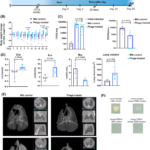
- Bacteriophage therapy for the treatment of Mycobacterium tuberculosis infections in humanized mice
- New publication on wastewater epidemiology